Technical data
Project description
- New construction of the Gateway Gardens S-Bahn station and the associated 2.20 km long tunnel
Construction method
- Tunnelling using the cut-and-cover method
Geology
- Loose rock, Quaternary sediments over cohesive Tertiary layers
General data
Project
Gateway Gardens Tunnel, Lot 2
Client
Deutsche Bahn AG
Contractor
ARGE Tunnel Gateway Gardens, Lot 2,
TGF Wayss & Freytag Ingenieurbau
Construction period
February 2016 to December 2019
Net construction sum
120 million €


Relief FOR THE ROADS AND THE ENVIRONMENT
After a construction period of just three years, the four-kilometre S-Bahn link to the new Gateway Gardens district at Frankfurt Airport went into operation on time.
The business park, which will provide 18,000 jobs in office and conference buildings, hotels, restaurants and retail outlets, can now be reached in just under ten minutes from Frankfurt Central Station using the S8 and S9 lines.
A central location and optimal transport links are two characteristics that characterise the new Gateway Gardens district in Frankfurt am Main, as it is located at one of Europe's most important transport hubs. On the site of the former American housing estate Gateway Gardens, in the immediate vicinity of Frankfurt Airport, the new quarter is being built with office buildings, a hotel, congress centre and retail outlets.
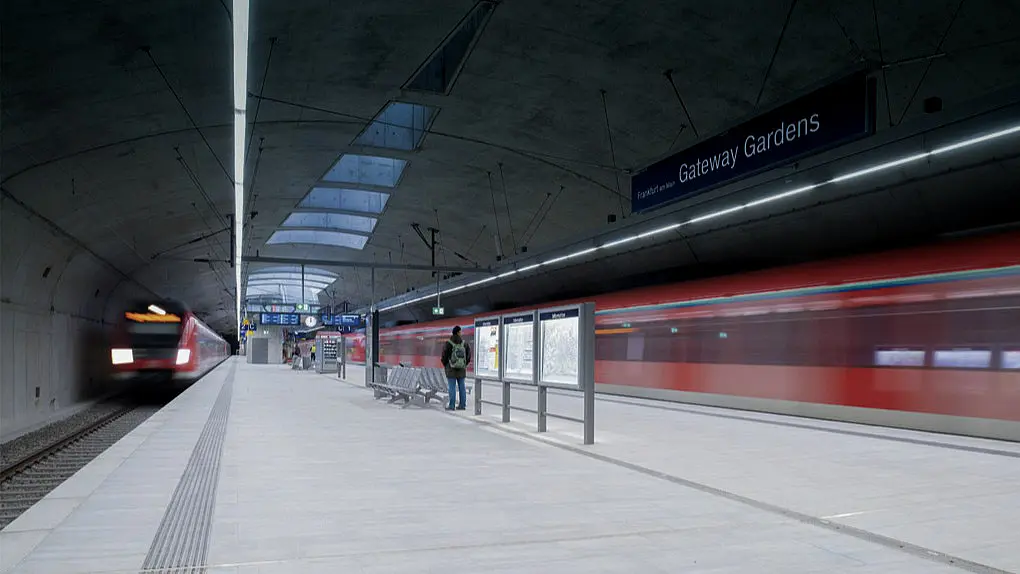
The "Gateway Gardens" S-Bahn station now connects the public transport system with the highly attractive site. Wayss & Freytag Ingenieurbau, Mitte division, built the centrepiece of the S-Bahn line with a roughly 2 km long double-track tunnel. This involved driving under the A5 Frankfurt - Darmstadt motorway and the entire Gateway Gardens site. The client for the infrastructure project is DB Netz AG.
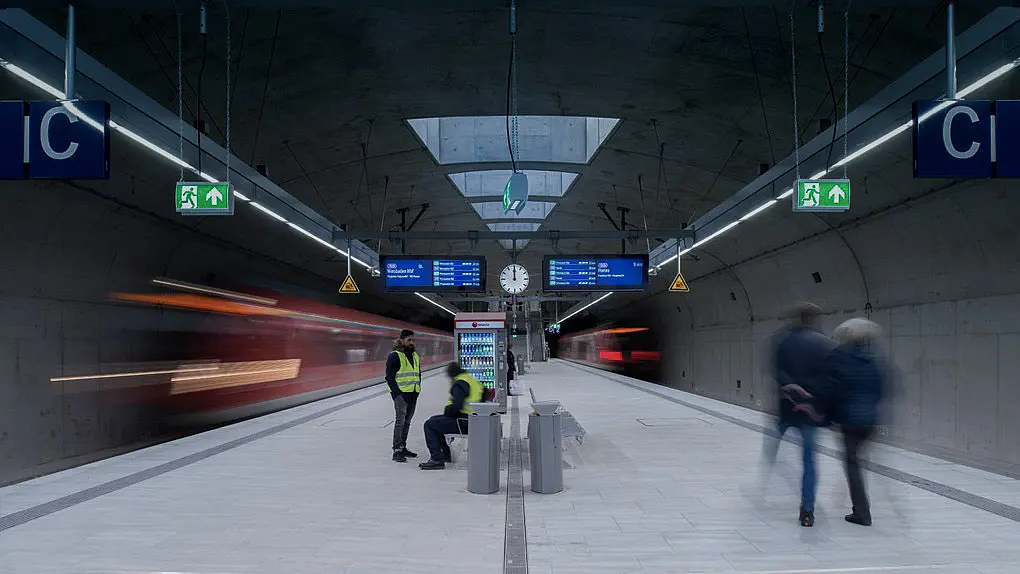
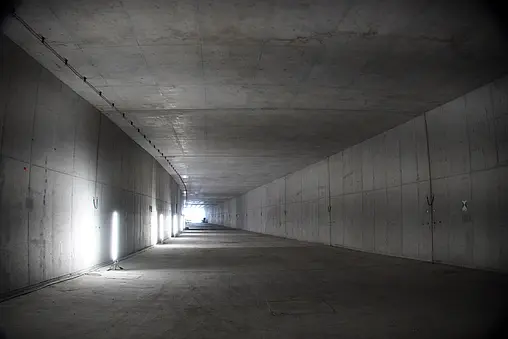
The tunnel was built using the cut-and-cover method. The excavation pit was built using bored piles, soldier piles and sheet pile walls. In the area under the motorway, work was carried out using the cut-and-cover method. The tunnel has a cross-section of around 11 metres wide and 6 metres high. Around 900,000 cubic metres of earth were moved and 180,000 cubic metres of concrete used in its construction.
According to forecasts, around 13,000 journeys a day will be shifted from car to rail thanks to the new rail link. The neighbouring road network is expected to be relieved by around 27 percent.
Further projects
Frankfurt
Sustainable mobility for Frankfurt’s Europaviertel
München
Extension of underground line 5
Frankfurt am Main
Expansion of local transport in the Rhine-Main region