First production hall and 500 jobs to be created by 2024 • ICE trains can be serviced more quickly here than at any other facility • One of the largest projects aimed at strengthening the regional economy in Lusatia
Deutsche Bahn (DB) has begun construction of the new railway maintenance depot in Cottbus. Today’s ground-breaking ceremony marks the start of work on the first of what will eventually be two maintenance halls. The first ICE 4 trains will be maintained in this hall in just two years’ time. On the building site, 500 red balloons marked out the floor plan of the new maintenance hall. They also symbolised the first 500 new jobs and training places that will be created here by 2024.
The project is one of the first and most significant initiatives aimed at strengthening the economy in the Lusatian coal-mining region. Together with the federal government and the state of Brandenburg, DB is supporting this transition and creating new, high-quality industrial jobs. Once the second workshop is completed in 2026, there will be a total of 1,200 new jobs. DB is fully committed to digitalisation and automation: Cottbus will become DB’s most modern maintenance depot.
Olaf Scholz, Federal Chancellor:
“The construction of the new railway depot in Cottbus shows how structural change can be achieved. Innovative projects like this not only create good jobs – they also bring new economic vitality and long-term sustainability to the entire region.”
Richard Lutz, Chief Executive of Deutsche Bahn:
“The new depot in Cottbus is being built at record speed. Today we are holding the symbolic ground-breaking ceremony – and in just two years’ time we will be servicing the first ICE 4 trains here. At the same time, we are creating exciting and state-of-the-art jobs in a sector with a promising future. We need this new facility so that our ICE fleet can continue to grow and so that more people choose to travel by rail. This is the only way we can achieve our climate targets.”
Dietmar Woidke, Minister-President of Brandenburg:
“Today marks the launch of a flagship project for structural change in Lusatia. Deutsche Bahn and the Federal Government have kept their word. I would like to express my thanks for that. This strengthening of the region is a key element in Lusatia’s development into a model region for climate protection and economic growth. This is also because up to 1,200 new industrial jobs are being created here. Significant progress is being made – especially when you consider that this railway depot was under threat of closure just a few years ago. Replacing lost jobs with new, sustainable ones is an absolutely essential prerequisite for successful structural development as part of the phase-out of lignite. The depot is set to become operational two years earlier than originally planned.”
Michael Theurer, the Federal Government’s Commissioner for Rail Transport: “Railway
transport supports more than half a million jobs in Germany. New technologies creating highly skilled jobs are making this environmentally friendly mode of transport increasingly attractive. By placing a clear focus on this mode of transport, we are not only actively combating climate change but also pursuing a comprehensive employment and structural policy. This project is a further positive contribution to structural change in the Lusatian lignite mining region. This is because the investments made here strengthen both the region and rail transport throughout Germany.”
As part of the Group’s ‘Strong Rail’ strategy, DB is continuously expanding its ICE fleet. By the end of the decade, around 450 ICE trains are set to be in service. By 2024 alone, the number of ICE 4 trains will grow from just under 100 at present to 137. More trains require greater maintenance capacity. The new depot in Cottbus makes a significant contribution to this, ensuring that trains are back on the tracks quickly and that more people can travel in a climate-friendly and comfortable manner.
Visualisation of the new plant
The new workshops are being built on the site in front of the existing DB facility in Cottbus. The first workshop has two tracks and is 445 metres long; the second workshop will have four tracks and be 570 metres long. This will make it DB’s first workshop dedicated to major maintenance of ICE 4 trains. During this process, the trains will be partially dismantled and heavy components such as bogies will be replaced.
What makes these workshops special is that even the 374-metre-long XXL ICE trains, with 13 carriages and 918 seats, can enter the facility at full length. As for the shorter ICE trains, two trains – each around 200 metres long and comprising seven carriages – can fit on the tracks one behind the other. This allows staff to work on all carriages simultaneously, which speeds up train maintenance. A full overhaul of an ICE 4, including all necessary steps, is expected to take less than two weeks at the new depot. Previously, such an overhaul on an ICE took up to five weeks.
New: Raised tracks in the workshop halls provide ergonomic workstations where staff can easily work on side panels and wheel sets. Bogie changers specially developed by DB are installed in the hall floor. This allows staff to slide the bogies out sideways for further work without having to lift heavy loads. Components can also be replaced much more quickly, which means trains spend far less time in the depot than usual and are back in service for customers sooner.
Investments totalling one billion euros are planned under the Coal Regions Investment Act. Through this Act, the federal and state governments are supporting the regions affected by the coal phase-out in Brandenburg, the Free State of Saxony, Saxony-Anhalt and North Rhine-Westphalia in creating sustainable jobs and new economic structures.
Wayss & Freytag Ingenieurbau AG, together with the Rhomberg Sersa Rail Group, Arcadis GmbH and LOGSOL GmbH, is a contractor for the construction of the new ICE maintenance depot. For the first time, Deutsche Bahn is relying on the innovative ‘Rail Partnership Model’, which is being scientifically supported by the Technical University of Berlin. Thomas Paetzold, a member of the Executive Board of Wayss & Freytag Ingenieurbau AG, attended the ceremony and emphasised: “As the main contractor, we are looking forward to working with all parties involved in the ‘Rail Partnership Model’. With its collaborative and transparent approach, this innovative pilot project is setting new standards in the planning and execution of complex construction projects.”
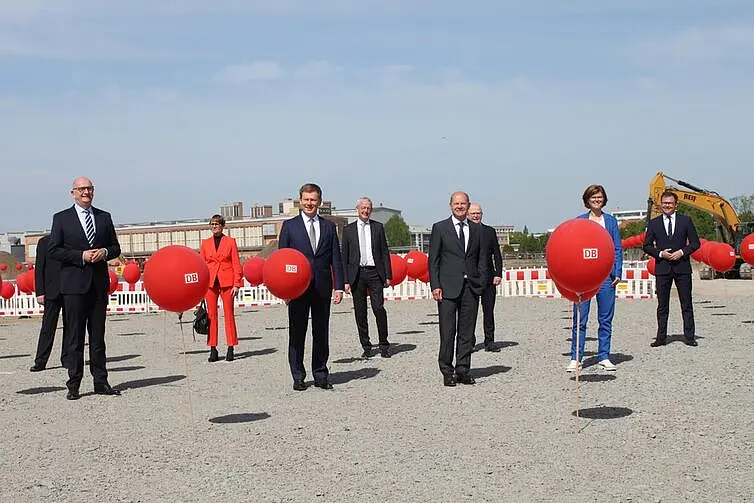
Photo: Wayss & Freytag Ingenieurbau AG
Ground-breaking ceremony for structural change: construction of the new railway depot in Cottbus begins. On the building site, 500 red balloons marked out the floor plan of the new workshop. They also symbolised the first 500 new jobs and apprenticeships that will be created here by 2024. Pictured: Dietmar Woidke, Minister-President of Brandenburg; Jörg Steinbach, Minister for Economic Affairs of Brandenburg; Marietta Tzschoppe, Mayor of Cottbus; Richard Lutz, Chairman of the Executive Board of DB AG; Guido Beermann, Minister for Infrastructure and Regional Planning of the State of Brandenburg; Olaf Scholz, Federal Chancellor; Michael Theurer, Federal Government Commissioner for Rail Transport; Daniela Gerd tom Markotten, Executive Board Member for Digitalisation and Technology at DB AG; Carsten Schneider, Minister of State and Federal Government Commissioner for Eastern Germany