New factory hall being built at record speed - Cottbus plant supports the transport turnaround with additional maintenance capacity - DB creates 1,200 new industrial jobs and apprenticeships in Lusatia
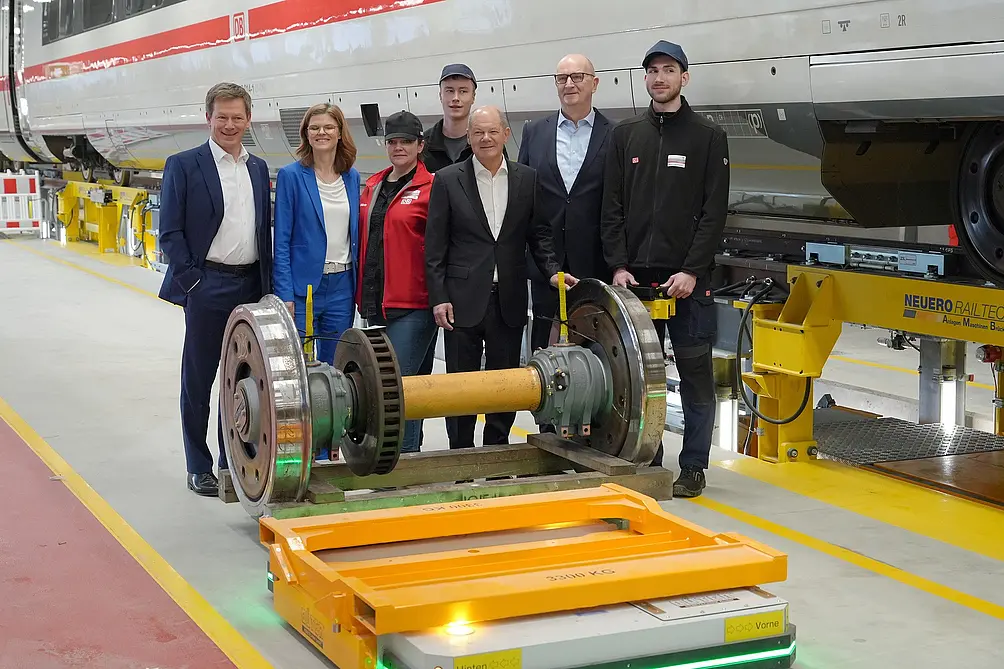
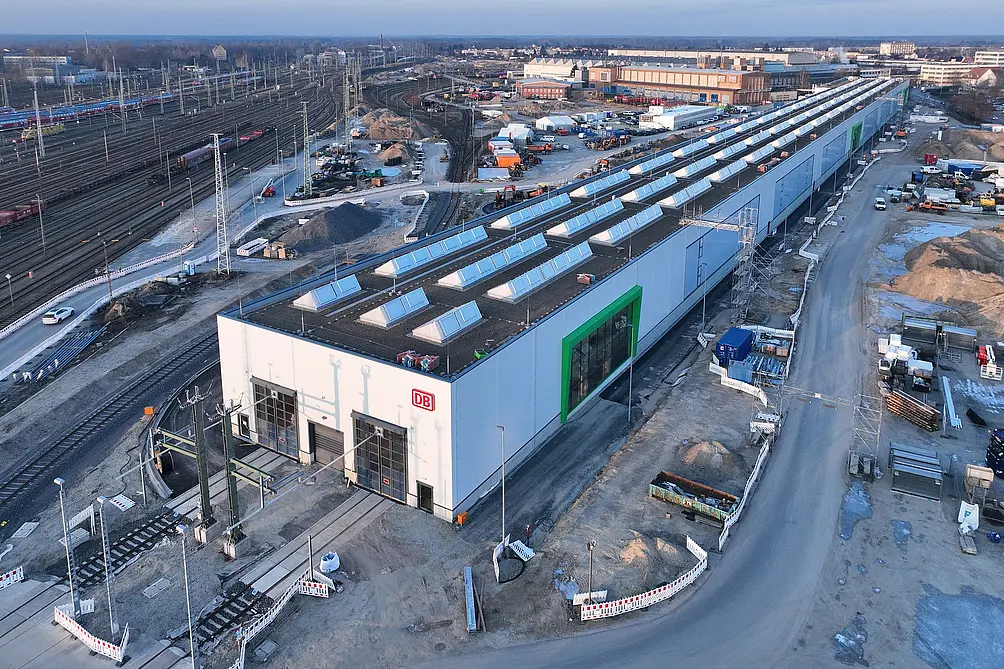
Deutsche Bahn (DB) is keeping its word: less than 20 months after the ground-breaking ceremony and thus at record speed, DB officially opened the new ICE maintenance workshop in Cottbus today. Federal Chancellor Olaf Scholz, Brandenburg's Minister President Dr Dietmar Woidke and DB CEO Dr Richard Lutz jointly opened the almost 450-metre-long workshop, where the heavy maintenance of DB's ICE 4 fleet will take place.
DB is initially creating 450 new highly qualified industrial jobs and apprenticeships at the Cottbus site and expects to create a total of 1,200 by 2026. The Group has also strengthened vocational training and significantly increased the number of apprenticeships. This means that half of the jobs to be filled at the plant in 2026 can be realised with the company's own trainees.
The ICE 4 is the backbone of Deutsche Bahn's long-distance transport, and DB has ordered 137 of these trains. DB is continuously expanding its ICE fleet as part of its "Strong Rail" Group strategy. By the end of the decade, a total of around 450 ICE trains of various types are to be on the rails. More trains also require more maintenance capacity. With innovative technology, the new plant in Cottbus will ensure that the trains get back on track quickly, that more people can travel in a climate-friendly and comfortable way and that the transport transition in Germany succeeds.
Lighthouse for Lusatia with radiance for the transport transition
Olaf Scholz, Federal Chancellor: "The "Neue Werk Cottbus" sets standards for major projects throughout Germany. Deutsche Bahn has erected a sophisticated building here in a very short space of time. That's what I mean when I talk about our new German pace. Deutsche Bahn has courageously embarked on something new, the "rail partnership model". The co-operation between Deutsche Bahn and LEAG for the "New Plant" is also a prime example of how it works: even if the jobs change, the good jobs stay here. Deutsche Bahn has also come to Cottbus because it can and wants to draw on the experience and qualifications of the people of Brandenburg."
Richard Lutz, CEO of Deutsche Bahn: "The new Cottbus plant is a central building block for the further expansion of our services and indispensable for Strong Rail and the transport turnaround. In Germany's most modern maintenance plant, highly qualified employees will ensure that the ICE 4 is back in service for our passengers more quickly. We are also creating attractive jobs in the region and thus contributing to a successful structural change. The Cottbus plant is already a beacon of progress and change in our country. And we are continuing this success story with the construction of the second hall."
Dietmar Woidke, Minister President of Brandenburg: "The launch of the railway plant is a great milestone in the structural strengthening of Lusatia. I am delighted that we have managed to fulfil our promise in the shortest possible time thanks to a joint effort: We are creating new and future-proof jobs before the phase-out of coal-fired power generation. I am very grateful for this, as it also strengthens trust in political promises. Our persistence during the negotiations on the coal compromise is paying off: Many jobs in the centre of the city are now secure. The new building shows that Lusatia is developing into an outstanding location for innovative technologies. I am particularly pleased that Deutsche Bahn, together with LEAG, is making an above-average commitment to training young people here. However, this project also shows that short planning, approval and implementation times are possible in Germany if everyone involved has one goal and all the wheels mesh together. This Brandenburg pace should become a benchmark."
Dr Anja Sternberg, Head of Division North, Wayss & Freytag Ingenieurbau AG: "We are delighted to have made an important contribution to the realisation of this important project with the construction of the hall, including the foundation, building envelope and interior fit-out. A great success and an example of how quality, adherence to deadlines and cost reliability can be ensured within a very short construction period using the alliance model."
During heavy maintenance, some of the trains are dismantled and heavy components such as traction motors or bogies are replaced. This can be done in the new plant, which is specially designed for the ICE 4, in just around two weeks - faster than in any other DB plant.
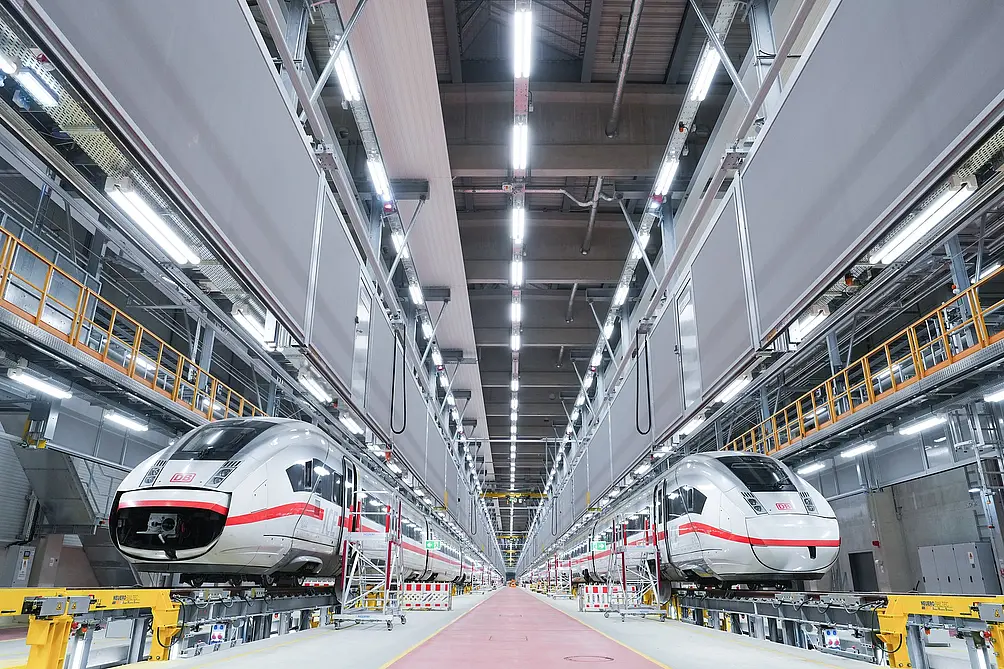
The 374 metre long XXL-ICE with 13 carriages and 918 seats fits into the almost 450 metre long factory hall. Two of the shorter, seven-car ICE trains, each around 200 metres long, can stand one behind the other on the two maintenance tracks. The trains no longer have to be divided for maintenance - as is the case in other factories. Employees can work on all carriages at the same time.
Another hall with a total of four tracks is already under construction on the factory site. It is scheduled to go into operation in 2026.
State-of-the-art technology and automation at the plant ensure more efficient and simpler workflows, which speed up maintenance processes and reduce the workload for employees: the two maintenance tracks are raised so that the side flaps and wheelsets of the trains are easily accessible. Specially developed bogie changers are installed in the hall floor. The heavy bogies can be moved out from underneath the train for further processing.
Employees in Cottbus can identify parts and components using an app and order them to their work location on the train. Augmented reality glasses allow technicians and engineers from other locations to be called in to work in Cottbus, with tips and instructions being displayed directly in the field of vision. This means that the trains are quickly and reliably available again for journeys in Germany, Austria or Switzerland.
The significantly earlier commissioning of the ICE plant than originally planned is due to various factors: DB AG has implemented a new, cooperative procedure (rail partnership model) for planning and realisation, which ensures rapid process development, team-oriented action by the partners and short coordination channels. In addition, all parties involved worked together closely and very constructively during the necessary coordination for the approval procedures. The task force set up in the State Chancellery under the leadership of Minister President Woidke and DB board member Daniela Gerd tom Markotten also contributed to this.
Source: Deutsche Bahn AG
Copyright: Deutsche Bahn AG / Volker Emersleben
Copyright: Deutsche Bahn AG / Oliver Lang
Copyright: Deutsche Bahn AG / Oliver Lang